



“Intelligent World 2035”: Ten Technology Trends – A Huawei Analytical Overview
Huawei’s Intelligent World 2035 sets out ten defining technology trends that serve as both the backbone of its vision and a framework for understanding the coming transformation of the global economy, industry, and governance. The analysis is not just predictive; it positions these trends as catalysts for change with strategic significance and practical value.
The report’s foresight, systematic approach, and bold projections are striking. Below is a summary of the ten trends and their implications.

- Toward the Physical World: The Path to AGI
Artificial General Intelligence (AGI) is seen as the ultimate goal of AI—systems with human-level cognition, autonomy, and creativity. Huawei argues that AGI will become the most transformative force of the next decade, though it still faces formidable challenges.
- Three Decades of Evolution: 1) Statistical learning revived AI in its first decade; 2) deep learning drove breakthroughs in perception; 3) Transformer models ignited cognitive AI; 4) the next decade will go “Beyond Transformers.”
- Three Engines: Data-driven experience, rule-driven reasoning, and practice-driven action will together form “world models” that allow AI to truly engage with the physical world.
- From Tools to Decision Partners: AI Agents Drive Industry Transformation
AI “agents” will evolve from simple assistants into decision-making collaborators. Their success depends on maturing technology, trust frameworks, and business ROI. By 2035:
- Early stage: productivity assistants in customer service, sales, office tasks.
- Mid-stage: breakthroughs in drug discovery, professional consulting, cost reduction.
- Long term: embodied robots and AI PCs reshape human experience, opening trillion-dollar industries.
The human–machine relationship will shift from division of labour to true symbiosis.
- Human–AI Collaborative Programming: Reinventing Software
The complexity of software is rooted in human limitations. Large models have already transformed programming, alleviating bottlenecks and boosting productivity.
- Co-programming will become mainstream, with models and formal methods complementing each other.
- AI agents will generate adaptive, “malleable” applications from natural-language prompts, while professional developers continue to build mission-critical systems.
Future software will blend deterministic logic, neural networks, and agent orchestration.
- AI and the Mirror World: Immersive Interaction
Interaction will move from 2D screens to multi-modal, spatial, and sensory-rich experiences.
- Interfaces will progress from keyboards to gesture sensors, voice, and eventually full five-sense integration.
- Devices may include gesture-sensing rings, pulse-tracking necklaces, ultra-light 3D glasses, and brain–computer interfaces.
The result: a seamless fusion of physical and digital realities.
- From Apps to Agent Ecosystems
Instead of millions of isolated mobile apps, the future internet will be an ecosystem of interconnected AI agents.
- User commands will trigger cooperative multi-agent workflows across services.
- Success metric: “end-to-end task success rate” will define competitiveness.
The formula for multi-agent strength: strong foundational models × (coordination frameworks + specialisation + learning + trust).
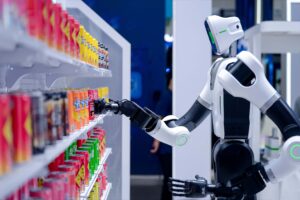
- Embodied Intelligence: Crossing into Trillion-Dollar Industries
AI is gaining a physical form through embodied intelligence—merging AI with robotics, sensors, energy systems, and networks.
- Autonomous Driving: By 2027, L4 pilots; by 2030, scaled L4 in selected contexts; by 2035, widespread L4+ and early L5 trials.
- Robotics: Around 2030, robotics may see its “ChatGPT moment” with vision-tactile-language-action models. By 2035, home robots could cost under US$10,000.
- Low-Altitude Economy: Advances in battery energy density (towards 800 Wh/kg) and hybrid power systems could make personal aerial vehicles feasible by 2035.
- Beyond the Von Neumann Architecture: New Compute Paradigms
By 2035, global compute demand could be 100,000 times higher than in 2025, driven by pre-AGI models. Meeting this requires breakthroughs in:
- Materials: beyond silicon to low-dimensional materials.
- Engineering: 3D heterogeneous integration, wafer-level computing.
- Architecture: from compute–storage separation to in-memory and neuromorphic designs.
- Paradigms: from classical to analog, optical, brain-inspired, and quantum computing.
- Data as Intelligence: The New Storage Paradigm
Data is the “new fuel.” By 2035, over 70% of data will be “warm” or “hot,” constantly feeding AI models.
- Traditional three-tier storage will evolve into a two-tier “hot–warm/cold–warm” structure.
- New storage must handle contextual, stateful, and evolving data—enabling continuous learning and fast rollbacks while cutting costs.
- From Mobile Internet to the Agent Internet
Connectivity will expand from 9 billion people to 900 billion devices and intelligent agents.
- PC Internet: on-demand, file-driven, few producers.
- Mobile Internet: always-on, rich media, everyone a producer.
- Agent Internet: real-time, hyper-dimensional, humans and agents as co-producers and co-consumers.
Networks will evolve to ultra-broadband, ultra-low-latency, secure, integrated sensing–comms–computing.
- Energy Tokens: AI as the Nervous System of Energy Networks
Energy is the ultimate constraint. By 2035, renewables will surpass fossil fuels, with wind and solar >50% of generation. Hydrogen and advanced nuclear will complement this shift.
- Space-based solar pilots (10MW in orbit by 2035) and progress in fusion could redefine supply.
- Energy “tokens” managed by AI will dynamically allocate every joule, turning the energy grid into an intelligent nervous system.
Conclusion
Huawei frames Intelligent World 2035 not only as a technology roadmap but as a manifesto for an “intelligent civilisation.” It positions AI’s evolution from a tool of efficiency to a partner in human progress.
As the report notes:
“Only when technology is woven into our lives, families, businesses, and environment can it truly advance civilisation.”
The vision is clear: by 2035, AI will permeate industry, infrastructure, and society, enabling a sustainable, intelligent future.
Subscribe to our Newsletter
Join our mailing list for exclusive updates and promotions!
