



HealthTech in Southeast Asia: A Region on the Cusp of Digital Transformation
The health technology landscape in Southeast Asia is evolving at a pace that few anticipated even five years ago. The region, home to more than 670 million people, has historically struggled with fragmented healthcare systems, uneven infrastructure, and varying levels of public and private investment. Today, however, the convergence of digital health tools, artificial intelligence, and preventative care models is reshaping how patients access care, how doctors make decisions, and how governments plan health policies.
A Shifting Healthcare Context
Healthcare expenditure in Southeast Asia has traditionally lagged behind that of developed economies. World Bank data shows per capita health spending in the region ranges from US$130 in Vietnam to more than US$600 in Singapore — a fraction of what is spent in Europe or the US. Yet demographic pressures, urbanisation, and rising consumer expectations are forcing systems to adapt.
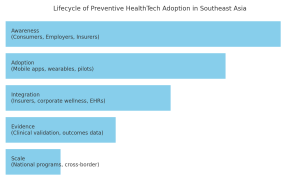
COVID-19 accelerated this trajectory. Digital consultations, mobile apps, and telehealth platforms filled gaps when hospitals were overwhelmed. More importantly, the pandemic normalised the idea that healthcare delivery could be decoupled from physical visits, paving the way for HealthTech to become a mainstream component of care.
Where Investment is Flowing
Venture capital has been brisk. According to DealStreetAsia, digital health start-ups in Southeast Asia raised more than US$1 billion in combined funding between 2020 and 2023. Singapore has emerged as a hub, with government-backed initiatives such as Healthier SG and the National AI Strategy creating fertile ground for data-driven health companies. Thailand, Malaysia, and Indonesia are also nurturing ecosystems, often with hospital conglomerates partnering start-ups to accelerate adoption.
Preventive health is one of the fastest-growing segments. Rising incidence of non-communicable diseases (NCDs) — such as diabetes, cardiovascular disease, and obesity — has underscored the need for solutions that engage consumers before crises occur. This is where companies like Aktivolabs have stepped in.
Aktivolabs: Measuring Health Risk in Real Time
Founded in Singapore, Aktivolabs focuses on quantifying and predicting health risks through a suite of mobile-first products. Its flagship solution, AktivScore, is a dynamic risk assessment tool that measures an individual’s likelihood of developing chronic disease based on lifestyle, behavioural, and biomarker data. The app engages users directly but is also integrated into corporate wellness programmes, insurers’ offerings, and health provider systems.
Recent progress has been notable. In 2024, Aktivolabs expanded its partnerships with insurers in Singapore and India, integrating its digital biomarkers into underwriting processes. This move reflects a broader trend in which insurers are adopting real-time health data to personalise premiums and incentivise healthier behaviour. The company has also partnered with multinational employers to roll out workforce wellness initiatives across Southeast Asia, giving them reach into diverse populations.
Aktivolabs’ approach illustrates a key theme in regional healthtech: the shift from treatment to prevention, where predictive analytics and continuous monitoring enable earlier interventions. For governments facing ballooning healthcare costs, such models offer a potential lever to bend the cost curve.
Policy and Regulatory Tailwinds
Regulation remains uneven across the region, but governments are increasingly open to digital health. Singapore’s Ministry of Health has introduced licensing frameworks for telemedicine providers and established sandbox programmes for new health technologies. Indonesia’s Ministry of Health has been working on standardising electronic health records (EHRs), while Vietnam’s digital health strategy emphasises interoperability and data sharing.
These frameworks, while still maturing, provide reassurance to investors and corporates. They also open the door for cross-border collaborations, especially in clinical trials, AI applications, and cloud-based health platforms.

The Competitive Landscape
The Southeast Asian healthtech market is fragmented, with start-ups competing against entrenched hospital groups, regional insurers, and global technology players. Telemedicine firms such as Halodoc (Indonesia) and Doctor Anywhere (Singapore) have become household names, while regional hospital chains like IHH Healthcare are increasingly adopting digital interfaces. Big tech companies, from Google Health to Apple, are also expanding their health footprints in Asia, creating both competition and partnership opportunities for local innovators.
What differentiates companies such as Aktivolabs is their emphasis on risk stratification — providing quantifiable, actionable insights rather than simply digitising existing healthcare processes. This positions them well in a market where prevention is becoming a fiscal as well as medical priority.
Challenges Ahead
Despite the momentum, obstacles remain. Interoperability between national health systems is limited, meaning patient data often cannot move seamlessly across borders or even between providers within a country. Cybersecurity concerns are growing, particularly as sensitive genomic and biometric data are stored on cloud platforms. Affordability also remains a constraint in lower-income countries, where healthtech solutions may be out of reach for large segments of the population unless supported by public subsidies or NGO funding.
What Comes Next
The next phase of growth will likely focus on three themes:
- Integration with national health strategies. As governments look to digitise health systems, start-ups that align their offerings with policy goals — such as chronic disease management or universal health coverage — will have an advantage.
- Cross-sector partnerships. Insurers, pharmaceutical companies, and consumer health brands are increasingly seeking health data and analytics to shape product strategies.
- Regional expansion. Companies like Aktivolabs demonstrate the scalability of models that work across borders, particularly when they adapt for cultural and behavioural differences.
Southeast Asia’s healthtech landscape is still in its early innings. But if momentum continues, the region could leapfrog traditional healthcare models, embracing a hybrid of preventative care, digital monitoring, and AI-driven insights. For patients, this means earlier interventions and more personalised care. For investors, it represents a market with growth potential and strategic significance.
As Aktivolabs’ trajectory shows, the winners will be those who can marry predictive analytics with practical, scalable solutions. In a region where healthcare challenges are vast but opportunities even greater, healthtech may prove to be one of Southeast Asia’s defining industries of the next decade.
Subscribe to our Newsletter
Join our mailing list for exclusive updates and promotions!
