



Global Landscape of Genomic Sequencing and the Rise of Predictiv Care
Genomics has long been heralded as the foundation of precision medicine. By decoding the genetic blueprint of individuals, clinicians can anticipate disease risk, tailor treatments, and accelerate drug discovery. In the past decade, advances in sequencing technology, cloud computing, and artificial intelligence have made large-scale genomic applications more feasible. Yet the ecosystem varies widely across geographies: the United States remains the innovation hub, Europe is building strong regulatory and collaborative frameworks, and Asia is rapidly emerging with unique datasets and new business models.
At the centre of Asia’s genomic surge is Predictiv Care, a Korean health-tech company led by Dr. Sajung Yun, and Artificial Intelligence visiting scholar at Stanford University, which is developing AI-driven algorithms to process genomic and medical data at scale.
which is developing AI-driven algorithms to process genomic and medical data at scale. Their story underscores how Asia can move from being a consumer of Western innovations to becoming a global innovator in its own right.
The United States: Innovation and Capital Density
The United States continues to lead in both genomic sequencing capacity and commercialisation. Illumina and Thermo Fisher dominate sequencing platforms, while a wave of health-tech firms — from 23andMe to Helix and Color Genomics — have brought consumer genomics into mainstream awareness. Crucially, the US capital markets, with their deep pools of venture and public equity, have enabled genomics firms to fund R&D and pursue ambitious clinical trials.
Regulatory oversight by the FDA, while sometimes slowing commercial rollouts, has provided global benchmarks for clinical validity and safety. The US also benefits from a vast ecosystem of academic medical centres and National Institutes of Health initiatives, such as the All of Us Research Program, which aims to sequence one million genomes.
Europe: Regulation, Collaboration and Ethical Guardrails
Europe has moved deliberately, often prioritising ethics, data governance, and cross-border collaboration. The EU’s General Data Protection Regulation (GDPR) has set global standards for privacy, directly influencing how genomic data is stored, shared, and monetised. Large-scale projects like the UK Biobank (with 500,000 sequenced participants) and Genomics England have provided robust infrastructure for both research and public health planning.
Continental Europe has launched initiatives such as “1+ Million Genomes” (covering 22 countries), which aims to make genomic and clinical data accessible across borders for research, diagnosis, and personalised medicine. The focus on interoperability and public-private collaboration offers lessons for Asia, where fragmented systems still hamper data sharing.
Asia: Scale, Diversity and Untapped Potential
Asia’s promise lies in its scale and diversity. With 4.7 billion people, the region offers genetic datasets unmatched by any other geography. Historically, much of genomic research has been skewed toward European ancestry populations, limiting the global applicability of findings. Asia can help correct this imbalance.
China has poured resources into sequencing capacity through companies like BGI Genomics, while Japan and Singapore have focused on integrating genomics into healthcare policy. Korea, meanwhile, has nurtured a cadre of ambitious start-ups and academic centres. Among them, Predictiv Care has emerged as a company combining AI algorithms with practical healthcare applications.
Predictiv Care: AI, Partnerships and Expansion
Founded by Dr. Sajung Yun, Predictiv Care develops AI algorithms to process genomic and medical data. Its core platform is a search engine covering more than 20,000 genes and 22,000 diseases, enabling clinicians and researchers to query associations between genomic variants and clinical outcomes. The company is conducting clinical trials at Seoul’s Eunpyung St. Mary’s Hospital and Korea University Guro Hospital, while also expanding into digital health check-up services and AI-driven drug discovery.
Dr. Yun’s vision is clear: genomic data should not remain siloed in academic labs but should be harnessed in real time for clinical and preventive use. As he has emphasised in public remarks, the integration of AI and genomic sequencing can create digital twins of patients, opening pathways to simulate disease progression and treatment outcomes.
Recent Progress and Data Assets
Predictiv Care has acquired significant datasets to train and validate its algorithms:
- 4,000 genomes from the Ulsan National Institute of Science and Technology (UNIST)
- 2,000 genomes from the Korea Institute of Oriental Medicine
- 60 centenarian genomes, providing unique insights into longevity
In parallel, the company has been developing MyData Twin Ontology for healthcare, enabling digital clinical trials and personalised simulations.

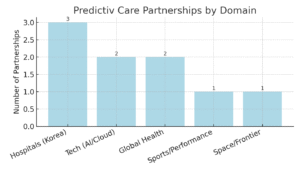
Partnerships have been central. In 2022, Predictiv Care collaborated with Naver on an employee health programme and fact-checking initiative. In 2024, it partnered with St. Mary’s Hospital and Naver’s HyperCLOVA X on digital twin research in kidney and liver transplantation and developmental hip dysplasia. Other projects include:
- UNIST’s 10K Genome Project, localising human digital twin efforts in Korea
- Gacheon University Gil Hospital on colorectal cancer liquid biopsy
- Digital Athletes USA, applying digital twins to enhance athletic performance
- NEOM City (Saudi Arabia), where Predictiv Care is an authorised medical supplier
- MBRSC (UAE space tech), supporting astronaut readiness with digital twin models
- NVIDIA, through its Inception program for AI start-ups
- SEHA Hospital (UAE), applying gene-based digital twins for hyperlipidemia management
Capital Market Strategy: IPO Pathways and Synergies
Predictiv Care has outlined an ambitious capital market roadmap. It plans to pursue a direct KOSDAQ listing from 2026, aiming for a full listing in 2027. Global expansion via NASDAQ is targeted for 2028. A SPAC listing remains a contingency plan. By 2025, the company expects to be incorporated as an affiliate of Predictive AI, creating synergy for global expansion.
Investors already include NAVER D2SF, Hana Securities, Muirwoods Ventures, and Predictiv Care (US), which participated in a 2022 funding round. M&A by global healthcare companies or big pharma is also under consideration, a strategy consistent with recent consolidation trends in biotech.
Competitor Analysis
In Korea, Predictiv Care’s peers include Lunit and Oncocross, both of which are already listed on KOSDAQ. Lunit specialises in AI-based radiology analysis, while Oncocross focuses on AI drug discovery. Predictiv Care differentiates itself by focusing on the genomics + AI + digital twin nexus, covering a broader scope of diseases and integrating directly with clinical workflows.
Internationally, companies like Illumina, 23andMe, and Genomics England represent reference points. Yet Predictiv Care’s positioning — combining Asian datasets, AI algorithms, and partnerships across healthcare, sports, and even space — reflects a unique hybrid model.

Challenges and Outlook
Challenges remain. Regulatory frameworks for genomic data in Asia are still fragmented, raising questions about cross-border data flows and patient privacy. Clinical adoption will require strong validation, and insurers may be slow to reimburse for genomics-based interventions. Public trust, especially around genetic privacy, must be carefully cultivated.
Yet the opportunity is immense. By 2030, the global genomics market is projected to exceed US$90 billion, with Asia contributing a rising share. If Predictiv Care executes its capital market plan, it could position itself as a global contender, moving from Seoul to Silicon Valley, Riyadh, and beyond.
Conclusion
The genomic sequencing landscape is global but differentiated: the US dominates innovation and capital; Europe leads in regulation and collaboration; Asia brings scale, diversity, and fresh models. Predictiv Care exemplifies how a new generation of Asian companies is moving from data collection to actionable insights — bridging clinical practice, digital twins, and AI-driven drug discovery.
For investors, policymakers, and clinicians, the rise of Predictiv Care signals not just the future of one company, but the next phase of genomics as a global, interconnected industry.
Subscribe to our Newsletter
Join our mailing list for exclusive updates and promotions!
